
Theki and Madani: The Traditional Dairy Technology of Panchapuri Valley
Theki and Madani (ठेकी र मदानी) represent an important part of Nepal's traditional dairy-processing technology and rural material culture. Used for generations in communities such as Panchapuri Valley, these wooden tools played an essential role in transforming curd into butter (नौनी), buttermilk (मोही) and ghee (घिउ). This article explores their historical development, traditional materials, craftsmanship, working methods and cultural significance while examining how modern technologies, changing lifestyles and migration are contributing to the decline of these traditional practices. Through documentation and preservation, Panchapuri Museum aims to safeguard this valuable heritage for future generations.
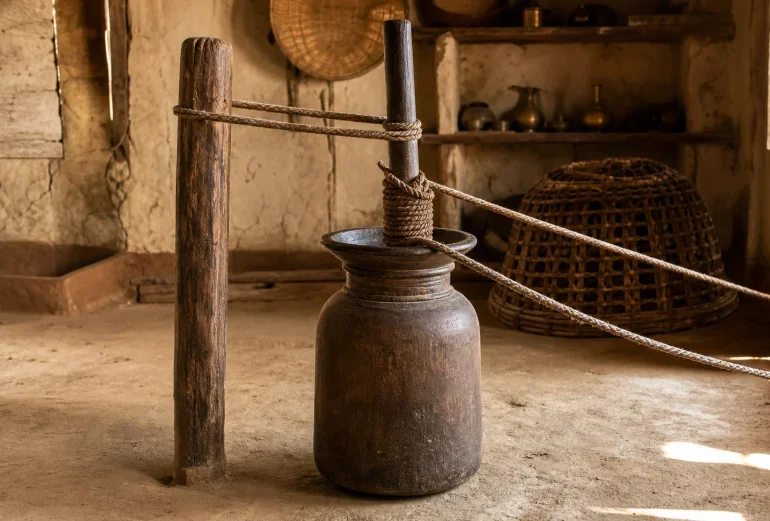
Theki and Madani: Preserving the Traditional Art of Dairy Processing in Panchapuri Valley
For generations, the people of Panchapuri Valley in Surkhet, Karnali Province, have maintained a close relationship with agriculture, livestock farming, and traditional food-production practices. Among the important technologies that supported rural household life was the traditional dairy-processing system known as Theki and Madani (ठेकी र मदानी). This simple yet ingenious technology played an essential role in transforming milk and curd into butter, clarified butter (ghee), and other dairy products.
Long before the widespread availability of electric appliances and modern dairy-processing machines, rural households depended on locally crafted wooden vessels and manually operated tools. Theki and Madani represent more than ordinary household equipment: they embody generations of practical knowledge, craftsmanship, resourcefulness, and the cultural relationship between people, livestock, forests, and food.
Today, however, these traditional technologies are gradually disappearing from everyday household use. As lifestyles change, younger generations increasingly adopt modern appliances and commercially processed dairy products. Consequently, many traditional tools are being replaced, abandoned, or kept in storage, while the knowledge of their construction and use is becoming less familiar to younger members of the community.
Through the documentation of such objects, Panchapuri Museum seeks to recognize the importance of everyday technologies as part of the region's material and intangible cultural heritage.
1. Understanding Theki and Madani
The traditional dairy-processing system consists of several interconnected components, each designed to perform a particular function.
Theki (ठेकी): A hollowed wooden vessel used for storing milk, setting curd, and churning fermented curd to separate butter.
Madani (मदानी): A wooden churning implement inserted into the Theki. Its lower end has a specially shaped paddle or rotating component that helps separate butter from curd.
Neti (नेती): A rope wrapped around the Madani, used to rotate it alternately in opposite directions.
Ghurna (घुर्ना): Small wooden crossbars or handles associated with the churning mechanism, depending on the local design.
Pora (पोरा): The lower paddle-like or blade-shaped component of the Madani that moves through the curd.
Pikra (पिक्रा): A wooden support or seating component used in some traditional churning arrangements.
The exact construction and terminology can vary between communities and geographical regions. These names should therefore be understood as documented traditional terminology, with local Panchapuri variations requiring confirmation from knowledgeable residents and artisans.
Understanding these individual components helps explain how a relatively simple collection of wooden and natural materials was transformed into an effective household dairy-processing system.
2. Raw Materials and Traditional Craftsmanship
The production of Theki and Madani depended primarily on locally available natural materials and the practical knowledge of traditional craftspeople.
Principal Materials and Their Traditional Uses
| Material | Nepali Name | Traditional Purpose |
|---|---|---|
| Timber / Wood | काठ | Making the Theki and Madani |
| Hardwood | कडा काठ | Making durable churning components |
| Softwood | नरम काठ | Making hollow wooden vessels |
| Bamboo | बाँस | Making parts of the churning implement |
| Rope / Cord | डोरी / नेती | Rotating the Madani |
| Wooden Paddle | पोरा | Churning the curd |
| Wooden Support | काठको अडेस / पिक्रा | Supporting the churning arrangement |
The selection of wood was important because the vessel needed to withstand repeated use, moisture, and the physical movement involved in churning. The vessel was traditionally carved from a suitable wooden log, hollowed out and shaped into a container. The choice of timber varied according to local availability and craftsmanship.
Different regions and craft traditions used different varieties of timber depending on their availability, durability, and suitability for household vessels. The specific wood varieties traditionally used in Panchapuri require further documentation through conversations with local artisans and elderly residents.
How Was a Theki Traditionally Made?
The Theki was not simply an ordinary wooden container. Its construction required an understanding of wood properties, proportions, hollowing techniques, and finishing.
A suitable piece of timber was selected, shaped, and hollowed to create the required internal space. The exterior was then refined to achieve a balanced shape, with an opening wide enough for adding curd and operating the Madani. Depending on the craft tradition, the vessel could be made using hand-operated woodworking tools or traditional turning techniques.
The Madani was separately prepared, with a long handle and a lower churning component. The Neti was then arranged around it to create a mechanism that could rotate the implement through alternating pulling movements.
This combination of woodworking, mechanical understanding, and practical experience demonstrates the sophistication of traditional rural technology.
3. How the Traditional Dairy-Processing System Worked
The Theki and Madani system was an effective household technology for producing butter and buttermilk from fermented milk.
The traditional process generally involved the following stages.
Step 1: Milk Collection (दूध सङ्कलन)
Fresh milk obtained from cows, buffaloes, or other locally raised livestock was collected in household vessels. It was generally filtered and boiled before being allowed to cool.
Step 2: Curd Preparation (दही जमाउने)
The cooled milk was transferred into a suitable container, and a small amount of previously prepared curd, locally known as Mau (माउ), could be added as a starter. The milk was then left to ferment and develop into curd (दही).
Step 3: Transferring Curd into the Theki (ठेकीमा दही राख्ने)
Once the curd was ready, it was placed in the Theki. Depending on the quantity and traditional practice, an appropriate amount of water was added to facilitate churning.
Step 4: Churning with the Madani (मदानीले मथ्ने)
The Madani was positioned inside the Theki. The Neti was pulled alternately, producing rotational movement in opposite directions. This continuous movement gradually separated the fat particles from the liquid.
Step 5: Butter Separation (नौनी निकाल्ने)
After sufficient churning, the separated butter gathered together and floated on the liquid. This butter, known as Nauni (नौनी), was collected by hand or with a suitable utensil.
Step 6: Collecting Mohi (मोही)
The remaining liquid was known as Mohi (मोही), a traditional buttermilk product. It was commonly consumed as a refreshing household drink and used in food preparation.
Step 7: Preparing Ghee (घिउ बनाउने)
The collected Nauni could be heated to produce clarified butter, known as Gheu (घिउ), which was used in cooking, religious practices, and household food traditions.
Through this process, households could transform fresh milk into several useful dairy products. The system demonstrates how traditional communities developed practical methods to make effective use of available agricultural and livestock resources.
4. Historical Development and Evolution of Theki and Madani
Theki and Madani belong to a long tradition of household dairy-processing technologies developed in communities where livestock farming was closely connected with everyday life.
In Nepal's rural and mountain regions, livestock provided milk, manure, agricultural support, and economic security. The ability to preserve and process milk was therefore an important part of household knowledge. Before modern mechanical equipment became widely available, communities developed simple tools using wood, bamboo, rope, and other locally accessible materials.
The development of this technology reflects several important stages:
Traditional household innovation: Communities developed wooden vessels and manual churning implements to process milk and curd.
Improvement in craftsmanship: Woodworkers refined the shapes, capacities, and construction of Theki and Madani to improve their usefulness and durability.
Integration into rural livelihoods: Dairy processing became a regular household activity, particularly in families involved in cattle and buffalo rearing.
Transmission of traditional knowledge: The techniques of making, maintaining, and operating these tools were passed between generations through observation and practical experience.
Introduction of modern alternatives: Metal containers, plastic vessels, electric mixers, cream separators, and commercial dairy-processing equipment gradually became more accessible.
Declining traditional use: As household practices changed, the demand for traditionally manufactured Theki and Madani decreased in many communities.
There is no established historical date for the origin of the specific Theki and Madani arrangement used in Panchapuri. Rather than assigning an unsupported date, it is more appropriate to understand it as part of Nepal's broader historical tradition of indigenous dairy-processing technology.
Its development was not necessarily the result of a single invention. Instead, it reflects generations of practical experimentation, adaptation, and knowledge-sharing among rural households and traditional craftspeople.
5. Theki and Madani in the Cultural Life of Panchapuri Valley
Panchapuri Valley, situated in Surkhet District of Karnali Province, has a long-standing relationship with agriculture, livestock farming, and household-based food production. In rural settlements, livestock rearing was not simply an economic activity; it was also connected with household food security, social relationships, and traditional ways of living.
Theki and Madani represent this relationship between people and their environment. Their materials came from the natural surroundings, their construction depended on local woodworking skills, and their operation required knowledge developed through everyday experience.
For generations, dairy processing was an important household responsibility. Fresh milk was transformed into curd, butter, Mohi, and Gheu, allowing families to make effective use of their available resources.
These practices also demonstrate how traditional technologies were adapted to local needs. Rather than depending on complex machinery or external energy sources, households used manually operated equipment that could be maintained and used within the community.
The Theki was therefore not merely a kitchen utensil. It was part of a broader system of rural production, traditional knowledge, and community life.
Its presence in traditional households reflects the relationship between agricultural practices, domestic responsibilities, food preparation, and the everyday experiences of earlier generations.
6. Changing Lifestyles and the Declining Use of Traditional Dairy Technologies
One of the major challenges facing traditional household technologies today is the gradual transformation of rural lifestyles.
In the past, Theki and Madani were familiar objects in households involved in livestock farming and regular dairy production. Today, many households increasingly rely on stainless-steel containers, plastic vessels, electric mixers, commercial butter, and other modern dairy-processing alternatives.
Several factors have contributed to this transformation.
Changing Agricultural and Livestock Practices
In some rural communities, traditional livestock-based household economies are changing. Reduced household involvement in cattle and buffalo rearing can also reduce the need for traditional dairy-processing equipment.
Migration and Changing Occupations
Young people increasingly move away from their ancestral villages for education, employment, and other opportunities. As a result, traditional household skills are not always transferred to younger generations.
Availability of Modern Equipment
Modern dairy-processing machines and household appliances offer convenience and reduce the physical effort required for manual churning. This has changed the way many families prepare dairy products.
Declining Traditional Craftsmanship
The production of wooden household vessels requires specialised knowledge and experience. When demand decreases, traditional craftspeople may find fewer opportunities to continue their occupation or train apprentices.
Changing Food Habits
The growing availability of commercially processed dairy products has also reduced the need for some traditional household production practices.
These changes should not be understood simply as the disappearance of old-fashioned objects. They represent a wider transformation in rural knowledge systems, local craftsmanship, food culture, and traditional livelihoods.
The declining use of Theki and Madani therefore raises an important question: how can communities preserve the knowledge associated with traditional technologies while adapting to changing lifestyles?
Documenting these objects, their traditional functions, and the experiences of people who used them can help ensure that this knowledge remains accessible to future generations.
7. Why Should We Preserve Theki and Madani?
Preserving Theki and Madani is important because they provide evidence of how earlier generations understood their environment, used available resources, and developed practical solutions to everyday challenges.
Their cultural significance can be understood through several dimensions.
Material Heritage: They represent traditional wooden craftsmanship and the use of locally available natural materials.
Technological Heritage: Their construction and operation demonstrate indigenous mechanical knowledge.
Food Heritage: They document traditional methods of preparing Nauni, Mohi, and Gheu.
Social Heritage: They reflect household responsibilities, cooperation, and intergenerational knowledge transfer.
Environmental Knowledge: Their production demonstrates the traditional use of locally available natural resources.
Historical Evidence: They provide future generations with tangible evidence of changing rural lifestyles and technologies.
Preservation does not necessarily mean returning to older methods or rejecting modern appliances. Instead, it means recognising the historical and cultural value of traditional technologies while allowing communities to benefit from modern development.
An old wooden vessel or churning implement may appear ordinary, but its construction, materials, use, and cultural associations can reveal important information about the society in which it was made and used.
Preserving such objects also helps communities maintain a connection with their history, traditional knowledge, and cultural identity.
8. The Role of Panchapuri Museum in Documenting Traditional Technologies
Panchapuri Museum, located in Panchapuri-09, Bidyapur, Surkhet, has an important opportunity to document and interpret the traditional technologies, objects, and knowledge systems associated with the cultural heritage of Panchapuri Valley.
Theki and Madani deserve attention as part of the museum's documentation of everyday rural life. Although these objects may appear ordinary to people who grew up using them, they carry valuable historical information about household economies, traditional craftsmanship, and food-production systems.
The museum can contribute to their preservation through the following activities:
1. Collection and Documentation
Identifying and documenting surviving examples of Theki, Madani, and their associated components. Recording their dimensions, materials, construction techniques, physical conditions, and traditional uses.
2. Oral History Recording
Interviewing elderly residents, former users, and traditional woodworkers about their experiences and knowledge. Their personal memories can provide valuable information about how these tools were made, maintained, and used in everyday household life.
3. Material Identification
Recording the local names of wood varieties, bamboo, ropes, and other materials used in their construction. This can help preserve traditional knowledge about natural resources and craftsmanship.
4. Traditional Process Documentation
Recording how milk was collected, curd was prepared, butter was separated, and Gheu was produced. Photographs, videos, and oral explanations can help document the complete dairy-processing process.
5. Digital Heritage Preservation
Creating high-quality photographs, videos, digital records, and educational articles about these technologies. Digital documentation can make traditional knowledge more accessible to researchers, students, educators, and interested members of the public.
6. Community Participation
Encouraging residents to contribute family histories, memories, photographs, and surviving household objects. Community participation is essential for ensuring that museum documentation reflects the experiences and knowledge of local people.
An especially important aspect is recording the local vocabulary associated with these tools. Words such as Theki (ठेकी), Madani (मदानी), Neti (नेती), Nauni (नौनी), Mohi (मोही), and Mau (माउ) are part of the knowledge associated with traditional dairy production.
The museum should also document variations in terminology and construction rather than assuming that every household or community used exactly the same design.
By documenting both the physical objects and the knowledge associated with them, Panchapuri Museum can help preserve an important part of the region's traditional technological and cultural heritage.
9. Conclusion: Preserving the Knowledge Behind Everyday Objects
Theki and Madani remind us that technological development did not begin with electricity, industrial machinery, or modern household appliances. Earlier generations also developed practical technologies through observation, experimentation, craftsmanship, and their understanding of natural materials.
What may appear to be a simple wooden vessel and a manually operated churning tool actually represents an interconnected system of traditional knowledge, agricultural livelihoods, food production, and community relationships.
As Panchapuri Valley continues to experience social and economic transformation, documenting these technologies becomes increasingly important. The physical objects may eventually disappear from everyday households, but the knowledge, memories, and cultural meanings associated with them should not be lost.
For Panchapuri Museum, preserving Theki and Madani is not simply about collecting old wooden objects. It is about recording the stories of the people who made them, the families who used them, the craftspeople who developed them, and the generations who inherited their knowledge.
Everyday objects are historical evidence. What once served a household can become an important source of knowledge for future generations.
Preserving traditional technologies is therefore not an attempt to stop progress. It is an effort to ensure that progress does not erase the knowledge and cultural experiences of the generations who came before us.
Digital Heritage Documentation | Panchapuri Museum