
Panchapuri Kageshwori Mai Temple The Hilltop Shrine That Opens Only Once a Year
On the hill straddling Surkhet and Achham, a remote temple opens its doors for a single day each year. Thousands climb before dawn for darshan of Kageshwori Mai, on the belief that a wish made here does not go unanswered.
Panchapuri Kageshwori Mai Temple: The Hilltop Shrine That Opens Only Once a Year
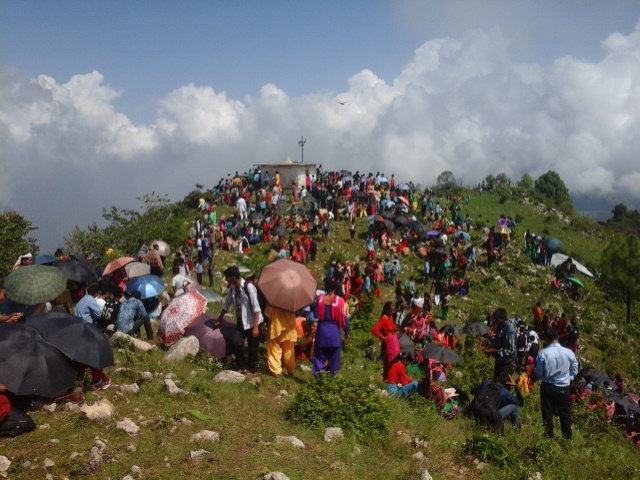
There is a small temple on a high ridge in Karnali Province that stays locked for three hundred and sixty-four days of the year. On the three-hundred-and-sixty-fifth the day before Janai Purnima its doors open at dawn, and by midday the narrow hill trail leading up to it is filled, shoulder to shoulder, with people who have walked for hours to reach it. By evening the doors close again, and the temple returns to silence until the same day comes around next year.
This is Kageshwori Mai of Panchapuri one of the more remarkable, and least documented, pilgrimage traditions in western Nepal.
Where Panchapuri Sits
Panchapuri lies in Panchapuri Municipality of Surkhet District, close to the district's border with neighboring Achham a stretch of Karnali Province where the terrain folds into steep, forested ridgelines. The temple itself sits at the very top of one of these ridges, on a high dada (hilltop) that gives the site its natural drama: from the temple courtyard, the view opens out across the surrounding hills of both Surkhet and Achham, a panorama that pilgrims often describe as being as much a part of the experience as the darshan itself.
Reaching it isn't a casual outing. Most devotees climb on foot, often starting well before sunrise so as to arrive in time for the temple's one day of opening. The elevation and the remoteness are, in a sense, part of what has kept the site's character intact this is not a roadside shrine visited in passing, but a destination that asks something of everyone who comes.
A Temple That Opens for One Day
What sets Panchapuri Kageshwori Mai apart from most temples in Nepal isn't the deity alone it's the calendar. The shrine remains closed to visitors for the entire year and is opened deliberately on a single occasion: the day immediately preceding Janai Purnima, the full-moon festival observed across Nepal each Shrawan (July–August) when Hindu men renew the sacred janai thread and communities perform Raksha Bandhan.
That timing is not incidental. In the wider Rishi Tarpani tradition observed on this day a ritual of remembrance and purification performed the day before Janai Purnima recitation of the Rudri (a Vedic hymn to Shiva) and the ceremonial wearing of the janai thread are central practices. Panchapuri Kageshwori Mai's single day of opening is built directly around this observance, which is part of why the crowds that gather here arrive specifically on that one eve, rather than on Janai Purnima itself.
For the rest of the year, the temple simply waits. There is something in that rhythm a sacred space that is deliberately inaccessible for all but a few hours annually that gives the single open day an intensity most temples, open every day, never quite have.
The Belief That Draws the Crowds
The pull of Panchapuri Kageshwori Mai rests on a specific and widely held belief among devotees: that a wish made here, in person, on this one day, does not go unanswered. It's a simple promise, and it's the reason people travel from well beyond the immediate villages of Panchapuri from across Surkhet, from Achham, and from further afield in Karnali to be there on the one day the doors are open.
This is the same logic that underlies many of Nepal's most enduring pilgrimage sites: a boon believed to be granted in exchange for the effort of the journey itself. The climb, the wait, the crowd none of it is incidental to the belief. It's part of what the visit is understood to mean.
As is true of many rural shrines across Karnali, the exact founding history of the Kageshwori Mai murti at Panchapuri isn't formally recorded in any single written source its story is carried instead through oral tradition, passed down by the priests and communities who have maintained the site across generations. That absence of a written record is, in its own way, a familiar pattern for heritage sites in this part of Nepal, and part of why documenting places like this matters before that oral memory thins with time.
A Landscape Worth the Climb
Ask anyone who has made the trip and the temple's setting comes up almost as often as the ritual itself. Panchapuri sits high enough that the hilltop offers a sweeping view across the ridgelines that separate and connect Surkhet and Achham districts: layered hills, forest cover, and on a clear day, a horizon that stretches well past what either district alone could offer from lower ground.
For a temple that's only accessible one day a year, this geography does something practical too it turns the pilgrimage into an event rather than a quick errand. People arrive early, some the night before, and the mountainside becomes, for those few hours, a genuine gathering point for the wider community: families reuniting, neighboring villages meeting each other on the trail, the kind of large-scale, once-a-year congregation that smaller, everyday temples rarely produce.
Why a Site Like This Matters
Panchapuri Kageshwori Mai is, in the truest sense, living heritage a tradition sustained entirely by the community that shows up for it every year, with no permanent staff, no year-round caretaking infrastructure, and until now, almost no digital footprint at all. Search for it and you'll find almost nothing written down; ask someone who's made the climb, and you'll get a story told with real conviction.
That gap is exactly the kind of thing worth closing. Sites like this remote, community-sustained, deeply meaningful locally but functionally invisible online are common across Karnali Province, and they represent precisely the kind of cultural heritage most at risk of being forgotten outside their immediate region simply because no record of them exists beyond memory. A basic, well-documented online presence the temple's story, its one-day tradition, photographs from the pilgrimage, directions for those wanting to make the climb would do two things at once: give the local community a way to share something they're clearly proud of, and give a wider audience, including Karnali's own diaspora, a way to find it.
A Living Tradition, Waiting to Be Told
There's a particular kind of authenticity in a temple that refuses to be a daily attraction one that asks its devotees to show up on exactly one day, at real physical cost, for a belief that clearly still holds real weight in the community. Panchapuri Kageshwori Mai is a reminder that some of Nepal's most meaningful heritage sites aren't the ones already on every tourist map. They're the ones still known mainly by word of mouth, kept alive one Janai Purnima eve at a time by the people willing to make the climb.
This article draws on local knowledge shared directly from Panchapuri, Surkhet, alongside available research on the region's Janai Purnima and Rishi Tarpani traditions. If you have additional history, photographs, or details about Kageshwori Mai temple, reach out documentation like this is best built with the community that knows it firsthand.