
Strengthening Small and Community Museums as Essential Cultural Infrastructure in Nepal
Nepal’s small and community museums play a vital role in preserving cultural heritage, indigenous knowledge, local histories and community identities. Yet, many face financial, institutional and professional challenges. This article examines their importance, highlights gaps in Nepal’s museum safeguarding framework, and calls for dedicated legislation, institutional support and sustainable mechanisms to protect these essential cultural institutions for future generations.
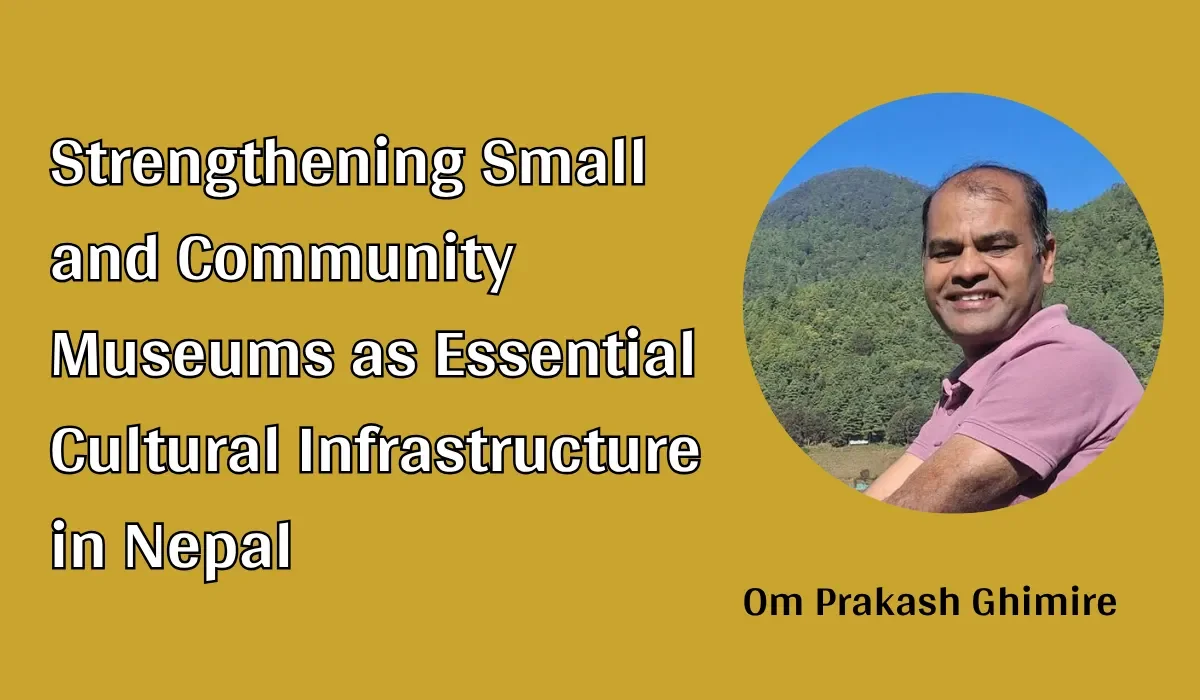
Om Prakash Ghimire
Introduction
Nepal’s cultural heritage is not preserved only in grand monuments, historic temples or national collections; it also lives in the everyday traditions, knowledge and memories of its communities. Yet, small and community museums, the institutions closest to these cultural roots remain among the most ignored to support and promote them. Home to approximately 30 million people, 124 languages and 142 ethnic communities, Nepal possesses extraordinary cultural diversity. These communities are the principal custodians of its traditions, identities and indigenous knowledge. Their meaningful participation and ownership are therefore essential to safeguarding this heritage.
According to estimates by ICOM Nepal, around 1,000 museums are registered with various government agencies, including the Office of the Company Registrar, District Administration Offices, and local governments. Most of these are community based, local, and small museums.
Community museums can serve as vital cultural centers, preserving and documenting local histories, traditional objects, crafts, musical instruments, oral traditions, rituals and indigenous knowledge. Beyond displaying collections, they promote cultural awareness, education, research, intergenerational learning and local development.
However, many operate with limited funding, inadequate professional support, weak safeguarding mechanisms and uncertain sustainability. Their dependence on founders, volunteers and irregular community or government assistance leaves them vulnerable to disasters, theft, deterioration and institutional discontinuity.
This exposes a fundamental contradiction: although constitutional provisions, UNESCO conventions and ICOM's professional ethics recognize cultural rights and heritage protection, the institutions closest to communities lack adequate mechanisms to fulfil these commitments.
When community museums disappear, we lose not merely objects, but cultural knowledge, identities, traditions and opportunities for future generations.
Small Museums, Big Cultural Contributors
The importance of small community museums should not be measured solely by the size of their collections, buildings, budgets or visitor numbers. Their significance lies in their relationships with communities and the cultural knowledge they preserve.
A traditional agricultural implement, for example, is not merely an old object. It may represent indigenous technology, environmental knowledge, livelihood practices and the historical relationship between people and their landscape. Traditional musical instruments, costumes and household objects can provide insights into cultural expression, social organization, craftsmanship and everyday life.
Community museums also have distinctive advantages. They are often closer to local people, cultural practitioners, traditional knowledge holders and the places where cultural practices originated. This enables them to document local histories, engage community members and provide learning opportunities that larger institutions may not easily offer.
They can become important educational centers for schools, spaces for intergenerational dialogue and platforms for documenting oral traditions, rituals, festivals, traditional skills and local cultural expressions. Small and community museums are therefore not peripheral institutions in the heritage sector. They are among the foundations upon which cultural continuity and diversity are sustained.
Constitutional Rights and State Responsibilities
The Constitution of Nepal, 2015, provides an important foundation for cultural rights and heritage protection. Article 32 recognizes the rights of individuals and communities to use their languages, participate in cultural life and preserve and promote their language, script, culture, cultural civilization and heritage. Article 51 directs the State towards the protection, promotion and development of historical, archaeological and cultural heritage, including research, dissemination and community participation. These provisions establish culture and heritage as matters of public responsibility and community rights rather than merely institutional interests.
Museums are among the institutions through which these rights can be practically realized. They preserve cultural resources, facilitate research, support education, document traditions and create opportunities for communities to participate in cultural life. However, constitutional recognition alone cannot ensure cultural continuity. Communities require institutions, resources and supportive policies through which cultural rights can be exercised.
This is where small and community museums become particularly important. Their safeguarding and sustainability should be understood as part of the practical implementation of constitutional cultural rights.
Museums as Institutions of Cultural Safeguarding
Nepal’s international heritage commitments provide additional foundations for museum safeguarding. The UNESCO 1970 Convention on the Means of Prohibiting and Preventing the Illicit Import, Export and Transfer of Ownership of Cultural Property emphasizes protecting cultural property against illicit trafficking. The 1972 World Heritage Convention establishes international cooperation for the protection of cultural and natural heritage. The 2003 Convention for the Safeguarding of the Intangible Cultural Heritage emphasizes safeguarding cultural practices, expressions, knowledge and skills recognized by communities as part of their heritage.
The UNESCO 2005 Convention on the Protection and Promotion of the Diversity of Cultural Expressions further recognizes the importance of cultural diversity and the conditions necessary for cultural expressions to flourish.
These international legal instruments show that cultural objects, traditional knowledge, artistic expressions and community practices are not isolated elements. They are parts of broader cultural systems through which communities maintain identity, creativity and continuity.
The UNESCO 2015 Recommendation concerning the Protection and Promotion of Museums and Collections, their Diversity and their Role in Society makes this relationship particularly explicit. It recognizes museums as primary means of safeguarding tangible and intangible testimonies of nature and human cultures. It also identifies museums as spaces for cultural transmission, intercultural dialogue, learning, social cohesion and sustainable development.
The Recommendation encourages Member States to adopt legislative and other measures necessary to implement its principles. For Nepal, this provides a clear policy direction that museums must be recognized not merely as collection-holding institutions but as essential cultural infrastructure.
Safeguarding as a Professional Responsibility
The International Council of Museums (ICOM) provides another important foundation through its Code of Ethics for Museums. The Code establishes professional principles and standards concerning collection stewardship, responsible acquisition, documentation, conservation, security, legal compliance, public engagement and institutional accountability.
Importantly, ICOM officially adopted a revised Code of Ethics on 25 June 2026. The revised framework reinforces museums’ responsibilities to protect cultural heritage, manage collections responsibly, strengthen public trust and serve society, while recognizing the diversity of museums and their different institutional contexts. This recognition of institutional diversity is particularly relevant to small and community museums.
Ethical safeguarding should not mean imposing identical requirements on every institution regardless of its resources. Rather, professional standards should be implemented through appropriate, proportionate and achievable mechanisms.
A community museum may require assistance to develop an inventory, establish basic security, improve storage, document provenance, prepare emergency procedures or train its staff. A larger institution may require more advanced systems. Both have safeguarding responsibilities, but their capacity to fulfil them differs.
Professional ethics must therefore be accompanied by professional assistance, institutional support and sustainable resources. Without these mechanisms, the expectation that every museum independently fulfils professional safeguarding responsibilities becomes unrealistic.
The Missing Mechanism
However, in the absence of museum dedicated law and museum-specific legislation, they are registered and operated within a fragmented legal and administrative environment governed by more than 15 different laws. Laws concerning ancient monuments, archaeological materials, archives, cultural property, institutional registration and local government provide important protection. However, they do not necessarily establish a comprehensive framework for contemporary museum governance and safeguarding.
The absence of a dedicated Museum Act and a coordinated national museum support mechanism creates difficulties for institutions, particularly small and community museums.
Many face challenges in maintaining inventories, establishing collection-management systems, developing security policies, undertaking conservation, recruiting qualified personnel and preparing for emergencies.
Their institutional continuity may also depend heavily on individual founders or local initiatives. When leadership changes, financial assistance declines or community enthusiasm weakens, museums can become vulnerable to closure or neglect. This is not simply an institutional management problem. It is a public policy issue.
Principally, Nepal has recognized the importance of culture and heritage but has not sufficiently established the institutional mechanisms necessary to protect the museums that preserve them. A safeguarding framework that concentrates exclusively on regulatory requirements, without providing technical and financial support, risks leaving the most vulnerable museums further behind.
The disappearance or deterioration of a community museum can produce multiple forms of cultural loss. Collections may be damaged, stolen, destroyed or dispersed. Local histories may remain undocumented. Traditional technologies and cultural knowledge may become inaccessible. Educational programmes, research activities and community cultural initiatives may be interrupted.
Museum's collections can support the interpretation of festivals, music, dance, crafts, costumes, oral traditions and indigenous knowledge. Museums cannot replace the communities in which living heritage is practiced. Nevertheless, they can contribute significantly to its documentation, interpretation, recognition and transmission. Their disappearance may therefore weaken an important institutional connection between cultural memory and contemporary community life.
In a society experiencing migration, urbanization, changing livelihoods and declining intergenerational transmission of traditional knowledge, this role becomes increasingly important.
The relationship between museum safeguarding and cultural safeguarding deserves greater recognition in Nepal’s heritage policy. Safeguarding a museum means protecting its collections, buildings, records, institutional knowledge, cultural relationships and educational functions. These elements collectively support the preservation and transmission of cultural heritage.
A museum that is adequately safeguarded can continue documenting local histories, supporting cultural practitioners, educating students, engaging communities and making heritage accessible to future generations. Conversely, an inadequately protected museum may become a source of irreversible cultural loss.
This understanding should also influence disaster-risk reduction and climate adaptation policies. Earthquakes, floods, landslides, fires and other emergencies can threaten museums and the cultural resources they preserve. Small museums frequently lack the technical capacity and financial resources to prepare for such risks independently.
Safeguarding must therefore include preventive conservation, risk assessment, emergency preparedness, collection documentation, recovery planning and access to professional assistance. The fundamental principle is clear: protecting museums is not merely protecting institutions or objects; it is protecting the cultural knowledge, identities and heritage relationships that communities sustain through them.
Museum Safeguarding and Sustainability
Nepal needs a coordinated national mechanism that recognizes small and community museums as essential components of cultural infrastructure. A dedicated Museum Act could establish the legal foundation for museum governance, safeguarding, professional standards, institutional classification, accreditation, sustainable financing and public accountability.
A national museum governance mechanism, such as a National Museum Council or an equivalent authority, could coordinate policy, technical assistance, capacity development, accreditation and cooperation among federal, provincial and local governments.
Such a mechanism should prioritize the development of a national museum inventory; the establishment of minimum safeguarding standards; the creation of a dedicated safeguarding fund; the provision of professional and technical assistance; active local-government engagement; meaningful community participation; support for institutional sustainability; and a credible system of accreditation and monitoring.
These measures will help identify and document all museums including small, community-based, private, and local-government museums while establishing practical requirements for documentation, security collection, conservation, risk assessment, and emergency preparedness. They will also provide predictable support for collection protection, infrastructure, digital documentation, training, and long-term institutional development. By integrating museums into local cultural policies, education, heritage inventories, and development planning, and by recognizing communities as genuine partners in documentation, interpretation, monitoring, and cultural transmission, this approach will strengthen museums as sustainable institutions for safeguarding Nepal’s diverse heritage.
These mechanisms should not treat small museums as institutions requiring charity. They should recognize them as public-interest cultural institutions whose safeguarding generates benefits for communities and society.
Conclusion
Nepal’s cultural diversity is sustained not only by monuments and nationally recognized heritage sites, but also by the knowledge, traditions, objects, and memories preserved within communities. Small and community museums make this heritage visible, accessible, and meaningful, connecting cultural rights with learning, participation, preservation, and transmission. Although the Constitution of Nepal, UNESCO instruments, and ICOM’s Code of Ethics provide important foundations, effective safeguarding requires legislation, institutional coordination, professional support, and sustainable financing. The future of Nepal’s museum sector cannot rely solely on founders, volunteers, and communities; safeguarding heritage must be a collective institutional responsibility. Therefore, community museums must be recognized as essential institutions of cultural rights, education, and sustainable development, making their safeguarding a national priority.
Mr. Ghimire is Museum Director of Panchapuri Museum and Secretary of ICOM Nepal. He can be reached via prakashdocument@gmail.com